
Everything you need to know about the GM100.
Key dates, commitments and practical information to help you decide whether the GM100 is right for you.
If you have questions after reading, we encourage you to get in touch.
Selection process
The GM100 selection process is designed to be rigorous, supportive and developmental.
It takes place in four stages:
-
The application form is your opportunity to introduce yourself and your motivations for applying to the programme.
Applications will open in early December and close on Sunday 23rd February 2026.
We are conscious of the limits of any written form. No application can capture the full richness of who you are, where you have come from, or the leadership you practise day to day. For that reason, we encourage you to see this stage as an introduction rather than a full presentation.
The form is deliberately short and focused. It serves two purposes:
To check alignment with the ethos, intent and design of the GM100
To understand how your experience and aspirations connect to the programme
You will be asked for:
Basic personal, sponsor and referee details
A brief outline of your recent career history
Short written responses to three reflective questions about your motivation, experience of closing disadvantage gaps, and what would most support your next step into headship
-
Once the application window closes, they are reviewed by assessors from the GM100 team.
At this stage, we are not looking for polished answers or a particular leadership style. We are looking for evidence of alignment, potential, reflection and readiness—and for leaders who will both contribute to, and benefit from, a strong cohort experience.
Shortlisted applicants are invited to the next stage.
-
Shortlisted candidates attend an in-person selection day in the region.
The GM100 Cohort 2 Selection Day will take place in Greater Manchester on Friday 1st May 2026.
The day is designed to be rigorous, supportive and human. It typically includes:
Individual and group activities
Opportunities to discuss leadership challenges and judgment
Time to ask questions and meet members of the programme team
Just as importantly, the day gives you space to decide whether the programme feels like the right commitment for you.
-
All successful applicants are invited to a 90-minute welcome webinar in the Summer Term.
This session:
Introduces the cohort and programme team
Sets expectations for the year ahead
Supports practical planning with your school or trust
The programme formally begins with an opening residential in September 2026, which marks the start of the shared learning journey.
What happens when
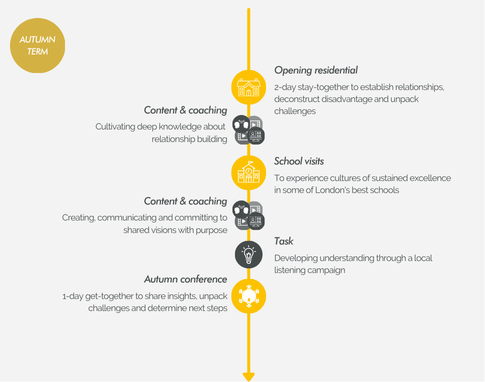
Autumn Term
The first term focuses on relationships—with self, with others, and with place.
Participants explore how trust, belonging and shared purpose are built in schools, particularly in complex contexts where relationships have often been strained.
Leaders examine their own leadership identity and values, and consider how relational cultures shape behaviour, learning and staff wellbeing. This term lays the foundations for a strong cohort and a clear moral compass for the year ahead.
Establishing relational cultures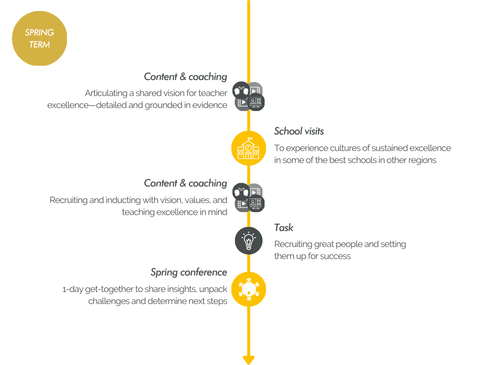
Spring Term
The spring term centres on the core work of schools: teaching and learning.
Participants explore how great teachers are developed, supported and retained over time—and the leadership conditions that make this possible.
The focus is on instructional culture, professional learning, and how leaders balance high expectations with care and support. Leaders consider how to grow excellence in diverse contexts, where recruitment, capacity and consistency can be real challenges.
Developing great teachers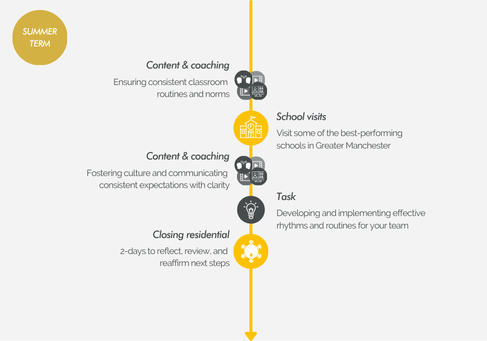
Creating cultures of excellence
Summer Term
The final term brings learning together, focusing on how leaders create and sustain cultures of excellence across a whole organisation.
Participants explore how vision, systems, routines and relationships interact—and how leaders make thoughtful trade-offs under pressure.
Attention turns to long-term impact: building resilient teams, strengthening leadership pipelines, and shaping school cultures that serve children and communities well over time.
Frequently asked questions
-
Participants should expect a meaningful but manageable commitment alongside a full-time role. Across the year, this typically includes:
Around 13 days out of school for in-person elements
Approximately 9 evening webinars
Around 15 hours per term of asynchronous learning (reading, videos and reflection)
We are happy to discuss reasonable adjustments where needed.
-
The programme blends in-person and online learning.
In-person elements include residentials, conferences and school visits.
Online elements include evening webinars, coaching and community-based learning.
Most online activity takes place outside the school day.
-
The GM100 is not currently an accredited qualification. It is designed to complement, not replace, formal pathways such as NPQs.
-
Indicative costs for the year are:
Primary: £1,500
Special/AP: £2,500
Secondary: £3,500
These costs cover programme delivery, travel for out-of-region visits, and accommodation and catering for residentials.
If cost is a barrier, please get in touch.
We do not want funding to be the reason a strong candidate cannot take part.
-
Across the year, participants should expect seven nights away from home. These are spread across residential elements and are planned well in advance to support personal and professional commitments.
-
The GM100 is not a replacement for the NPQH, nor is it an accredited qualification.
It is a complementary programme, focused on developing leadership judgement, confidence and readiness for headship through place-based learning, strong cohorts and sustained reflection.
Many participants choose to undertake the GM100 alongside, before or after formal qualifications, depending on their context and needs.
Next steps
If you’re considering applying—or supporting someone who might—we encourage you to explore the programme in full and get in touch.